Safai Karmachari Liberation & Empowerment Program
Establishing support systems and strengthening community action among Safai Karmachari women, youth, and sewerage workers for liberation, rehabilitation, and socio-economic empowerment.
The project has organized 1500 Safai Karmachari women, 600 youth, and 200 sewerage workers across seven states — Chandigarh, Punjab, Odisha, Rajasthan, Haryana, Uttarakhand, and Delhi.
- 60 Self Help Groups (SHGs)
- 60 Ambedkar Gender Equality Clubs (AGECs)
- 7 Sewerage Workers Collectives
Self Help Groups (SHGs)
52 SHGs comprising 120 women leaders meet monthly, engaging in savings and credit activities that reduce dependency on informal money lenders charging exorbitant interest.
- Reduced indebtedness and harassment by money lenders
- Access to emergency funds for education and healthcare
- Increased mobility and financial control
Financial literacy enabled women to envision dignified livelihoods. With project support, 7 SHGs successfully initiated income-generation activities.
Ambedkar Gender Equality Clubs (AGECs)
50 AGECs with 120 youth leaders held monthly meetings, focusing on Ambedkar ideology, equality, liberty, and leadership.
- Regular discussions on Ambedkar’s vision of social justice
- Sports and cultural activities to build unity and leadership
- Celebration of 8 Dalit and social justice observance days
Sewerage Workers Collectives
Awareness meetings addressed sewer deaths, legal protections, and the state's duty to ensure mechanization and dignified work.
Memorandums and petitions were submitted, followed by engagements with government officials on enforcing the Manual Scavenging Prohibition Act and Supreme Court orders.
Families of sewerage workers were engaged in forming Safai Karmachari enterprises, creating pathways for self-employment and rehabilitation.
Capacity & Institution Building
- 13 state-level monthly project team meetings
- National project management training
- 39 Community Resource Persons placed in 80 bastis
- 14 skill development programmes using traditional skills
Education, Health & Entitlements
Education
17 model education centres support children daily with academic assistance in safe learning spaces.
Health
- Health awareness camps in 23 bastis
- 63 blood pressure screening activities
Access to Entitlements
- 55 RTIs submitted for education and livelihood schemes
- 28 memorandums on dry latrines and sewer deaths
Advocacy & Social Action
- Memorandums submitted to 44 parliamentarians
- 21 community social actions in MP, UP, and Jharkhand
- Surveys identifying dry latrines across multiple states
Haryana – SHGs & AGECs
Lucky SHG – Garment Business
Munesh and other women transitioned from garbage collection to dignified garment sales. Today, they earn more with respect and independence.
Vandana SHG – Fast Food Venture
Seema now runs a food business, breaking caste barriers where the same hands once forced to clean drains now prepare food with dignity.
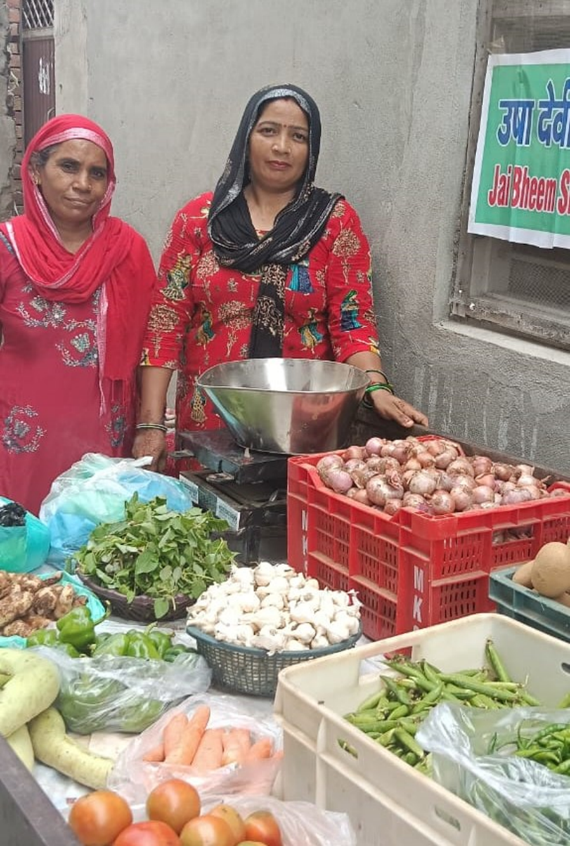
Jai Bhim SHG – Vegetable Vending
Usha Rani increased her income from ₹4,000 to over ₹10,000 and enabled her son to pursue B.Tech — a first in her family.
Punjab – SHGs & AGECs
AAS SHG – Food Business
Women liberated from scavenging established a food stall, reclaiming dignity and breaking the cycle of untouchability.
Sahas SHG – Footwear Shop
Women now confidently engage with markets, managing wholesale purchases and retail sales.
AGEC Youth – Punjab
Youth leaders shared experiences of organizing community events, advocacy, and leadership rooted in Ambedkar ideology.